

Use it to plan your own robot barista payback period.

Want to know more details?
Please, contact your manager.
Aleksandr Maksimovich
Business Development Manager
Nalarobot Robotics | Nalarobot Café
Mobile: +375 333 760 460
(WhatsApp | Telegram | Viber)
BLOG
What Is the Top Robotic Arm For Sale in 2026?
Choosing the top Robotic Arm For Sale in 2026 requires more than comparing prices and polished product photos. Buyers must examine payload, reach, repeatability, programming, safety features, and long-term support. A robot that looks impressive online may struggle with a simple pick-and-place task on a busy production line.
This guide evaluates leading robotic arms through practical, measurable criteria. We consider real workshop conditions, including limited floor space, changing lighting, vibration, and operator training. We also examine cycle speed, mounting options, energy use, maintenance access, and compatibility with grippers or vision systems. These details matter when a small error can misalign a component by several millimeters.
There is no perfect choice.
The strongest model for a factory may be excessive for a laboratory, school, or small business. Total ownership cost also includes integration, software updates, spare parts, installation, and technical service. That point is easy to overlook. Our comparison therefore combines manufacturer specifications with application-focused reasoning and cautious interpretation. Some published figures depend on ideal testing conditions, so they should not be treated as guaranteed workplace results. Readers should verify local requirements and request demonstrations before purchasing. The final recommendation will identify the most balanced option, while recognizing that budget, workload, operator skill, and future expansion can change the answer. Even experienced buyers can misjudge these factors. That is why this review focuses on evidence, usability, and honest limitations rather than a single attractive specification.
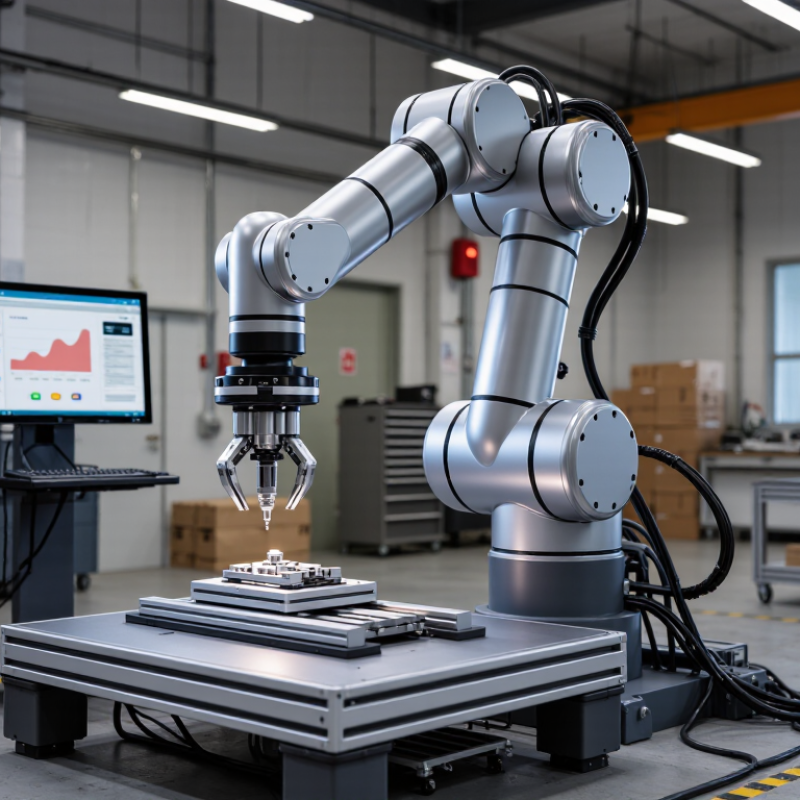
What Defines the Top Robotic Arm for Sale in 2026?
What defines the top robotic arm for sale in 2026 is not a polished brochure. It is dependable performance under real production pressure. A serious evaluation should measure payload, reach, repeatability, cycle time, and energy use together. One impressive specification cannot prove overall value.
Safety remains central. The arm should support force monitoring, guarded operation, emergency stopping, and clear risk assessment procedures. Its controller must communicate reliably with existing equipment and manufacturing software. Technicians also need practical training, readable diagnostics, and accessible replacement parts. These details often decide whether a system stays productive after installation.
Real testing matters.
I would examine the arm while it handles uneven workloads, tight spaces, temperature changes, and frequent tool movement. A reliable model should place a component accurately after thousands of cycles, not only during a short demonstration. Total ownership cost deserves equal attention, including programming time, maintenance, downtime, and integration labor. The cheapest purchase may become expensive later.
Still, no scoring system is perfect. A compact arm may outperform a larger model in a crowded cell, while a powerful unit may waste energy on light tasks. Human oversight also remains necessary, especially when processes change unexpectedly. The top robotic arm for sale in 2026 is therefore defined by measurable reliability, safe integration, adaptable control, and support that works beyond the sales contract. My evaluation would remain open to revision after long-term factory data becomes available.
What Is the Top Robotic Arm For Sale in 2026? - What Defines the Top Robotic Arm for Sale in 2026?
| Evaluation Dimension | Top-Tier 2026 Benchmark | Typical Commercial Range | Why It Defines a Top Robotic Arm | Priority |
|---|---|---|---|---|
| Payload Capacity | 5–30 kg for collaborative applications; 20–100+ kg for conventional industrial applications. | Approximately 3–30 kg for collaborative arms and 5–1,000 kg across heavy-duty industrial systems. | Higher payload supports larger tools, heavier workpieces, multi-part handling, and more demanding assembly or palletizing tasks. | High |
| Reach | 900–2,000 mm for general-purpose automation, with longer reach available for large work envelopes. | Approximately 500–3,200 mm, depending on arm configuration and application class. | A suitable reach reduces the need for additional linear axes, fixtures, or multiple robots while improving workspace coverage. | High |
| Repeatability | ±0.02–0.05 mm for precision industrial work; around ±0.05–0.15 mm for many collaborative applications. | Approximately ±0.02–0.20 mm, depending on robot size, payload, speed, and testing method. | Repeatability directly affects part placement, machine tending, dispensing, inspection, welding, and consistent product quality. | High |
| Axis Configuration | Six-axis articulation for maximum orientation flexibility; four- and seven-axis designs serve specialized layouts. | Four to seven controlled axes are common in industrial and collaborative robotic arms. | Six-axis motion allows the end effector to approach a workpiece from multiple directions and handle complex orientations. | High |
| Operating Speed | Joint speeds commonly reaching approximately 180–500°/s, with application cycle time validated under payload. | Roughly 100–600°/s by joint; actual tool-center-point speed depends on configuration and load. | High speed improves throughput, but the best system balances speed with accuracy, payload, safety, and process stability. | High |
| Safety Capability | Risk-assessed safety functions aligned with ISO 10218 and, where applicable, collaborative operation guidance in ISO/TS 15066. | Protective stop, emergency stop, speed and separation monitoring, power-and-force limiting, and safety-rated monitored stops are common functions. | Reliable safety integration can reduce guarding requirements, support human-robot collaboration, and simplify deployment in mixed workspaces. | High |
| Motion Accuracy and Control | Stable trajectory control, consistent path performance, collision detection, force or torque sensing, and smooth low-speed motion. | Position control is standard; force sensing and advanced compliance are available on many higher-specification systems. | Accurate and compliant motion is essential for insertion, polishing, deburring, surface finishing, assembly, and contact-sensitive operations. | High |
| End-Effector and I/O Compatibility | Standard mechanical mounting, integrated tool communication, configurable digital I/O, and support for pneumatic, electric, vision, and force-controlled tools. | Common interfaces include digital I/O, industrial Ethernet, serial communication, pneumatic lines, and tool-side power connections. | Broad compatibility reduces integration time and allows the same arm to support multiple tools and production processes. | High |
| Programming and Deployment | Graphical programming, offline simulation, reusable templates, automatic path generation, clear diagnostics, and support for common industrial communication protocols. | Teach pendants and graphical programming are widespread; offline programming, APIs, and simulation vary by system. | Faster programming lowers commissioning costs and makes the robotic arm more practical for high-mix or frequently changing production. | High |
| Vision and Sensing | Native or well-supported integration with 2D/3D vision, barcode and inspection systems, force sensing, and real-time process feedback. | Camera-based inspection and part location are common options; 3D vision and force control are increasingly used for flexible automation. | Sensing enables bin picking, quality inspection, adaptive assembly, error recovery, and operation with variable part positions. | High |
| Reliability and Duty Cycle | Industrial construction, repeatable performance over continuous shifts, protected joints, documented maintenance intervals, and application-specific uptime validation. | Many industrial arms are designed for continuous production; collaborative models may prioritize flexibility and easier redeployment. | Reliability protects production capacity and reduces unplanned downtime, maintenance interruptions, and quality variation. | High |
| Energy Efficiency | Efficient servo drives, regenerative braking, low standby consumption, and programmable power-saving modes. | Energy demand varies substantially with payload, motion profile, duty cycle, and arm size. | Lower energy use reduces operating costs and supports sustainability targets without sacrificing required production performance. | Medium |
| Footprint and Installation | Compact base, flexible mounting options, manageable total weight, and straightforward integration with workbenches, cells, or mobile platforms. | Base diameters commonly range from roughly 150–500 mm, while total arm mass varies from compact portable units to several hundred kilograms. | A compact installation can increase usable factory space and make the arm easier to relocate or integrate into existing lines. | Medium |
| Total Cost of Ownership | Balanced purchase price, tooling, software, safety equipment, installation, training, maintenance, energy use, and expected productivity. | Ownership cost varies widely by payload class, accessories, integration complexity, and required safety infrastructure. | The top option is not necessarily the least expensive unit; it delivers the strongest measurable return over its complete operating life. | High |
| Serviceability and Support | Accessible replacement components, diagnostic tools, documented procedures, training resources, remote support, and predictable maintenance planning. | Support coverage and spare-part availability vary by region and system complexity. | Strong serviceability shortens recovery time and protects production continuity after faults or application changes. | High |
Related Posts
-

How to Build a Large Robotic Arm for Beginners?
-

How to Choose the Right Robot Arm?
-

5 Compelling Benefits of Investing in a Robotic Arm for Your Business Expansion
-
Overcoming Challenges with Best Cnc Robot Arm Solutions for Global Buyers
-

Top 10 Large Robotic Arms You Should Consider for Purchase?
-
Discover the Best Robot Arm Solutions for Global Buyers?